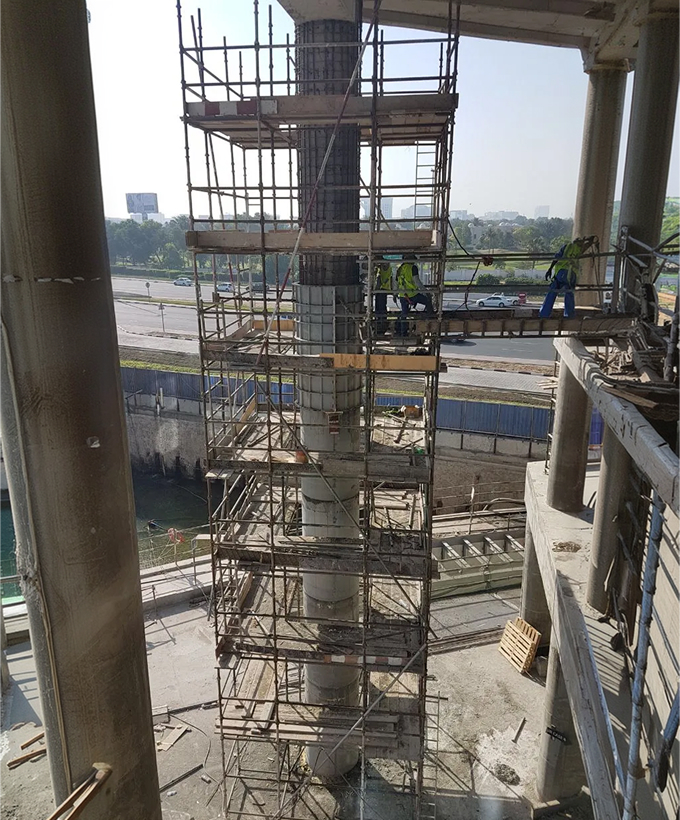
Concrete Jacketing and Thickening
Concrete jacketing delivers a robust capacity upgrade by increasing member size and confinement—restoring strength, stiffness, and long-term reliability.
Jacketing is often selected when structures are required to perform beyond their original design intent—such as increased live loads, revised functional use, or code-driven upgrades—particularly for columns and walls that govern overall stability and seismic performance. It is also a practical solution when condition assessments identify reduced capacity due to cracking, spalling, corrosion-related section loss, or other degradation mechanisms that require both repair and strengthening to restore reliability.Applications include column jacketing to improve axial capacity and seismic ductility, beam enlargement to increase flexural and shear capacity, slab thickening for higher load demands, and wall thickening to improve lateral resistance. Detailing is coordinated to ensure effective load transfer to the existing structure through connectors, dowels, and reinforcement development, and execution is planned around access, interfaces with finishes/MEP, and construction phasing. While jacketing adds thickness and weight, it offers a robust performance uplift and can be tailored using conventional concrete, micro-concrete, or shotcrete depending on site constraints and constructability.
Applications include column jacketing to improve axial capacity and seismic ductility, beam enlargement to increase flexural and shear capacity, slab thickening for higher load demands, and wall thickening to improve lateral resistance. Detailing is coordinated to ensure effective load transfer to the existing structure through connectors, dowels, and reinforcement development, and execution is planned around access, interfaces with finishes/MEP, and construction phasing. While jacketing adds thickness and weight, it offers a robust performance uplift and can be tailored using conventional concrete, micro-concrete, or shotcrete depending on site constraints and constructability.
Concrete Jacketing and Thickening
Concrete jacketing and thickening increase member capacity by enlarging the cross-section and enhancing confinement, stiffness, and overall robustness. This approach is well suited where substantial strength gains are required, where the existing element shows distress or deterioration, or where a durable, long-life solution is preferred as part of an asset upgrade program.
Concrete jacketing delivers a robust capacity upgrade by increasing member size and confinement—restoring strength, stiffness, and long-term reliability.
Jacketing is often selected when structures are required to perform beyond their original design intent—such as increased live loads, revised functional use, or code-driven upgrades—particularly for columns and walls that govern overall stability and seismic performance. It is also a practical solution when condition assessments identify reduced capacity due to cracking, spalling, corrosion-related section loss, or other degradation mechanisms that require both repair and strengthening to restore reliability.
Applications include column jacketing to improve axial capacity and seismic ductility, beam enlargement to increase flexural and shear capacity, slab thickening for higher load demands, and wall thickening to improve lateral resistance. Detailing is coordinated to ensure effective load transfer to the existing structure through connectors, dowels, and reinforcement development, and execution is planned around access, interfaces with finishes/MEP, and construction phasing. While jacketing adds thickness and weight, it offers a robust performance uplift and can be tailored using conventional concrete, micro-concrete, or shotcrete depending on site constraints and constructability.